Connect this guide with the rest of your visit in the Antalya trip planner. Read how the research is made and what its sources establish.
At a glance
Start here
- Place Karain above the travertine plain before trying to understand its archaeology.
- Think of it as a connected chamber system with deposits from different periods, not one room frozen in prehistory.
- Keep national, university and ICOMOS chronologies distinct where their summaries differ.
- Call Karain a UNESCO Tentative List site, never an inscribed World Heritage property.
01
The landscape comes before the classical cities
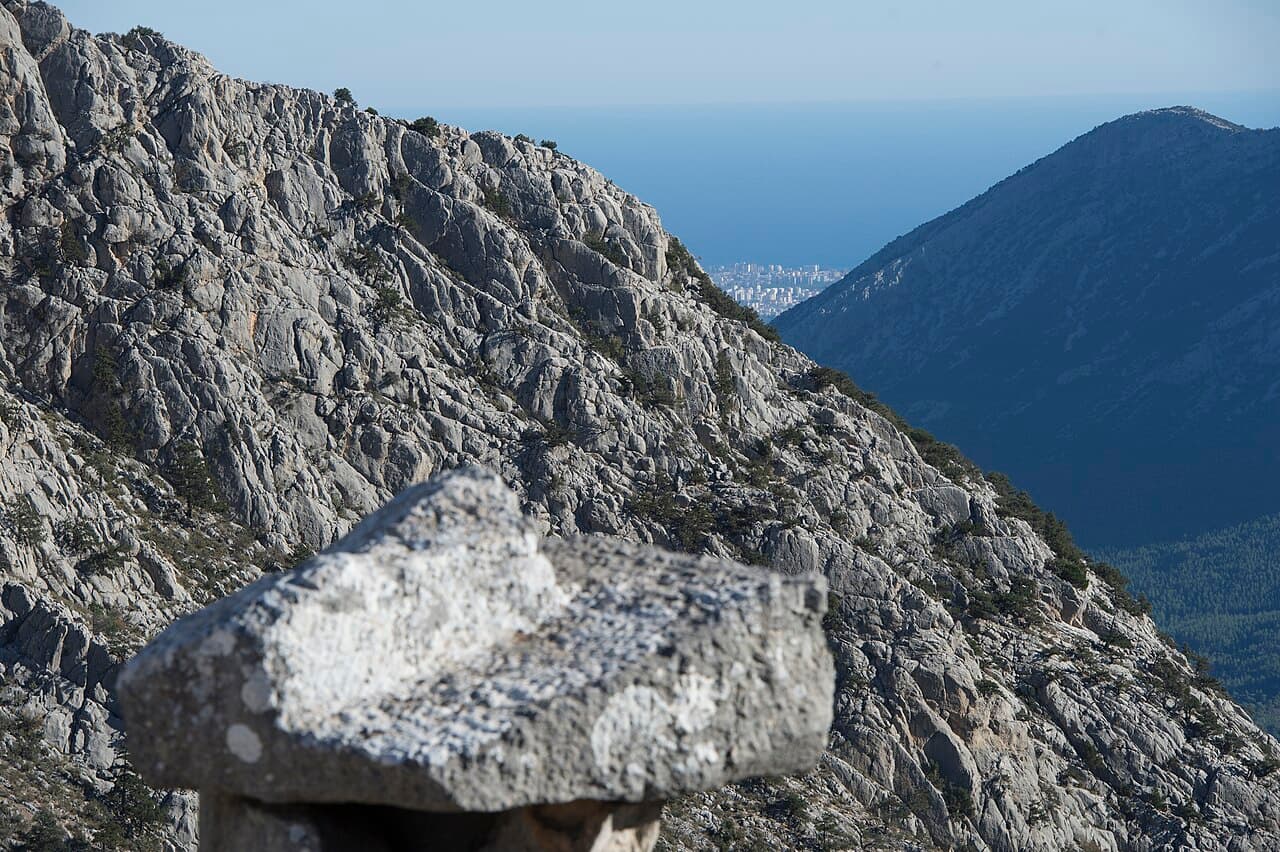
UNESCO's Tentative List description places Karain on the eastern slope of the western Taurus, about 430 metres above sea level and roughly 150 metres above the travertine plain. The Turkish Museums page locates it near Yağca northwest of Antalya. That elevated position matters: the cave overlooks a broad environmental zone whose water, animals and plant communities changed long before the region acquired monumental urban centres.
UNESCO's nomination text links the cave to a Pleistocene landscape that included a lake on the plain and open-air activity around it. This context prevents a misleading mental picture of people sealed inside a remote hole. The cave was one element in a larger lived territory. Archaeologists read what entered and remained in its deposits alongside the surrounding landforms to reconstruct movement and subsistence.
- Locate the cave on the Taurus slope rather than imagining it on Antalya's shoreline.
- Use the view over the plain to connect shelter with a wider resource landscape.
- Distinguish archaeological environmental reconstruction from the modern scene below.
02
Karain is a system of chambers
The Ankara University teaching material describes seven chambers, labelled A through G, while UNESCO refers to cavities and connecting passages shaped by calcite. This physical complexity is essential to interpreting the site. Material from one chamber or level cannot automatically stand for every period of use across the cave.
Archaeological labels can make the system sound tidier than it is. Sediment accumulates, people disturb earlier surfaces and excavation methods develop over decades. A plan of chambers therefore does more than help orientation: it records where evidence was found. When a display mentions a tool tradition or occupation phase, the chamber and stratigraphic position are part of the claim, even if a short visitor panel omits them.
- Replace the image of one cavern with connected archaeological spaces.
- Ask which chamber and layer produced a highlighted object.
- Treat calcite walls and passages as part of site formation, not decoration alone.
03
Its long chronology needs careful wording
Official summaries do not frame Karain's earliest sequence in exactly the same way. The Turkish Museums page presents a very deep occupation history, while the 2001 ICOMOS evaluation foregrounded deposits from the Upper Palaeolithic through later prehistoric and historic phases. UNESCO's current Tentative List entry uses a broad sequence across Palaeolithic and subsequent periods. These texts were written for different purposes and at different dates.
The responsible response is not to pick the most dramatic number and flatten the disagreement. Archaeological chronologies change as layers are reassessed and dating evidence improves. Karain's secure interpretive value is the exceptional length and variety of its record. Any precise age attached to a particular level should be traced to the excavation publication or current museum interpretation that supports it.
- Attribute precise chronological claims instead of presenting them as timeless consensus.
- Separate the age of a deposit from the age of the cave itself.
- Expect official summaries from different decades to emphasise different evidence.
04
The excavation has its own history
The Turkish Museums page dates systematic excavation at Karain to 1946. Ankara University's course material records a long first phase of work and a renewed programme from 1985. Those dates reveal why interpretations cannot be separated from research history: teams working decades apart brought different questions, recording systems and analytical techniques to the deposits.
An excavation date is not proof that every chamber has been completely resolved. Archaeology advances through documentation, comparison and reanalysis as much as through removing sediment. Karain should therefore be understood as an active body of evidence, not merely a place where discoveries happened in the past. Museum labels and heritage nominations are snapshots of that longer scholarly process.
- Use 1946 as the start of systematic research, not the moment the cave became known.
- Recognise the 1985 renewal as a change in research programme.
- Leave room for later analyses to revise older cultural or chronological labels.
05
Small stone tools answer large questions
Ankara University's material highlights microlithic stone industries from an Epipalaeolithic context in Chamber B. Such small worked pieces can appear visually modest beside sculpture from Perge, but they preserve decisions about raw material, technique and tool use. Repeated forms help archaeologists identify technological traditions and compare Karain with other sites.
The contrast with Antalya's classical collections is instructive. A carved statue announces its subject and patronage; a flake or microblade requires context before it becomes evidence. Its value depends on the layer, associated remains and manufacturing sequence. Karain asks the viewer to trade monumentality for resolution: apparently minor traces can document behaviour across periods for which written history does not exist.
- Judge stone artefacts by context and production evidence, not size.
- Connect a tool to its chamber, layer and associated material.
- Avoid using one artefact type as a label for every occupation of the cave.
06
Animal and plant remains rebuild lost environments
The Turkish Museums description emphasises fossil animal and plant remains as part of Karain's importance. UNESCO's landscape account adds the former lake and open-air context on the plain. Together, these sources show why the cave record is environmental as well as cultural. Bones, botanical traces and sediments help test what conditions surrounded the people who used the shelter.
These remains should not be turned into a colourful but unsupported scene of daily life. Presence in a deposit does not by itself prove how a species was acquired or used, and preservation is selective. The stronger story is methodological: several kinds of evidence are compared to distinguish climate, habitat, food processing and natural accumulation. Uncertainty is part of the reconstruction rather than a defect to hide.
- Keep environmental evidence separate from imaginative reconstruction.
- Ask whether remains were culturally deposited or arrived through natural processes.
- Read cave sediments together with evidence from the surrounding plain.
07
Tentative status is not World Heritage inscription
Karain has appeared on Türkiye's UNESCO World Heritage Tentative List since 1994. The World Heritage Centre page labels that status directly. An ICOMOS evaluation in 2001 recommended deferring further consideration and raised questions about the evidence, boundaries and management then presented. That historical evaluation is useful context, but it is not a current inscription decision or proof that the site's importance disappeared.
Precise language protects both the reader and the site. Say Tentative List, attribute the date and avoid the shorthand UNESCO site, which commonly implies full World Heritage status. For an actual visit, consult the current Turkish Museums page for access information and follow on-site boundaries. Archaeological deposits and cave surfaces are the evidence; touching, marking or removing material damages the very record that makes Karain exceptional.
- Use UNESCO Tentative List as the complete status description.
- Treat the 2001 ICOMOS document as a dated evaluation, not a current visitor notice.
- Verify access through the official national museum page before travelling.
Useful answers
Reader questions
Is Karain Cave a UNESCO World Heritage Site?
No. UNESCO lists Karain on Türkiye's Tentative List, where it has appeared since 1994. Tentative status means it may be considered within a future nomination process; it is not inscription on the World Heritage List.
Sources: UNESCO World Heritage CentreWhen did systematic excavation at Karain begin?
The Turkish Museums page gives 1946 as the beginning of systematic excavations. Ankara University records the earlier campaign and a renewed excavation programme from 1985, showing that the site's research history spans multiple phases.
Sources: Turkish Museums, Ministry of Culture and Tourism; Ankara University Open Course MaterialsIs Karain one large chamber?
No. Ankara University describes seven chambers labelled A through G, and UNESCO describes cavities linked by passages. Findings need to be understood by chamber and layer rather than assigned to the cave as a single undifferentiated space.
Sources: Ankara University Open Course Materials; UNESCO World Heritage CentreAre the artefacts from Karain only stone tools?
No. Stone industries are important, but the Turkish Museums page also highlights animal and plant fossil remains. The cave's significance comes from combining cultural material, biological evidence and stratigraphy across a long sequence.
Sources: Turkish Museums, Ministry of Culture and Tourism; Ankara University Open Course MaterialsRead the evidence
Sources and further reading
These sources support the relevant sections above. Plans and comparisons are editorial suggestions. Check operators for current arrangements.
- Karain Mağarası ↗Turkish Museums, Ministry of Culture and Tourism · Research date 14 September 2026
Karain's location near Yağca, elevation context, systematic excavation from 1946, long occupation sequence and animal and plant remains.
- Karain Cave ↗UNESCO World Heritage Centre · Research date 14 September 2026
Tentative List status since 1994, Taurus and travertine-plain setting, elevation, former lake context, chambers, passages and broad archaeological sequence.
- Karain Cave: ICOMOS Evaluation ↗ICOMOS via UNESCO World Heritage Centre · Research date 14 September 2026
The dated 2001 evaluation, its description of the stratigraphic sequence and its recommendation for further consideration on evidence, boundary and management questions.
- Karain Mağarası Yontmataş Endüstrileri ↗Ankara University Open Course Materials · Research date 14 September 2026
The seven chambers labelled A–G, excavation phases and Chamber B's Epipalaeolithic microlithic stone industry.
- Antalya Müzesi ↗Turkish Museums, Ministry of Culture and Tourism · Research date 14 September 2026
The museum's official description of a prehistory collection, used only to contrast contextual stone evidence with Antalya's better-known classical displays.